
A sneeze. A laugh. A run.
A particularly enthusiastic star jump…
And suddenly your bladder has decided it would quite like to join in.
If you experience a little bladder leakage when you cough, sneeze, exercise or lift something heavy, you are definitely not the only one. Bladder leakage in women is incredibly common and is often linked to something called stress urinary incontinence.
The important bit? Common does not mean you simply have to put up with it.
Let’s talk about what may actually be happening, why your pelvic floor matters and what your options are.
Why do I leak when I cough or sneeze?
When you cough, sneeze, laugh, run or lift something, pressure increases inside your abdomen and onto your bladder.
Usually, the muscles supporting your bladder and urethra help keep everything under control. But if those muscles are not quite strong enough to cope with that extra pressure, a small amount of urine can leak out. This is known as stress urinary incontinence.
And despite the name, it has nothing to do with feeling emotionally stressed.
So unfortunately, telling your bladder to calm down will not solve this one.
The NHS lists coughing, sneezing, laughing, heavy lifting and exercise among the common triggers for stress incontinence.
So, what does your pelvic floor actually do?
The pelvic floor is a group of muscles that sits at the bottom of your pelvis and supports organs including your bladder.
Think of it as part of the support system underneath everything.
These muscles also help control when you pass urine. Like any other muscle group in the body, the pelvic floor can become weaker or less effective.
And when that happens, you may start noticing things you did not before.
- Perhaps running suddenly feels slightly risky.
- Maybe you cross your legs before you sneeze.
- Or you have become suspiciously good at locating every toilet within a five-mile radius.
Those little changes are worth paying attention to.

Why does the pelvic floor become weaker?
There is not one single reason.
Pelvic floor weakness and urinary incontinence can be associated with several different factors.
Pregnancy and childbirth
Pregnancy puts extra pressure on the pelvic floor, and childbirth can stretch or weaken the muscles involved in bladder control.
That does not mean bladder leakage is something every mum simply has to accept forever.
Very common after children? Yes.
An unavoidable lifelong membership perk of motherhood? No.
Menopause and ageing
Changes as we age, including those around menopause, can affect the tissues and muscles involved in pelvic support.
Urinary incontinence becomes more common with age, although the NHS is very clear that it is not an inevitable part of getting older.
High-impact exercise
Running, jumping and other high-impact activities repeatedly increase pressure through the pelvic floor.
For some people, this is when weakness first becomes noticeable.
You might feel completely fine day to day but suddenly discover that a trampoline class and your bladder are no longer on speaking terms.
Weight and pressure on the bladder
Carrying excess weight can place additional pressure on the bladder and pelvic floor and may contribute to symptoms in some people.
Chronic coughing or heavy lifting
Anything that repeatedly increases pressure through the abdomen can place additional strain on the pelvic floor over time.
And sometimes there is more than one factor involved.
Is bladder leakage normal after having children?
It is certainly common.
Women are often incredibly good at quietly accepting things after pregnancy and childbirth because they assume they are simply part of becoming a mum.
Bladder leakage. Pelvic floor weakness. Changes to the body.
“Apparently this is just me now.”
But common does not mean there is nothing you can do about it. If bladder leakage is affecting you, it is worth talking about.
The NHS advises seeing a GP if you have urinary incontinence. They can help determine what type of incontinence you have and whether there could be another underlying cause.
What can you do about a weak pelvic floor?
Treatment depends on why you are experiencing symptoms and what type of urinary incontinence you have.
There are several different forms of incontinence, so getting the right assessment matters. For stress incontinence, conservative approaches are generally the starting point.
These can include:
- Pelvic floor muscle exercises
- Lifestyle changes
- Bladder training where appropriate
- Specialist pelvic health physiotherapy
- Maintaining a healthy weight where relevant
Pelvic floor exercises are commonly recommended and can be very effective, particularly when they are performed correctly and consistently.
The NHS recommends pelvic floor muscle training as one of the first non-surgical approaches for urinary incontinence.
But we also know real life happens.
Remembering to do pelvic floor exercises several times a day for months can be easier said than done.
Which brings us to one of the treatments we offer at Saddle House.
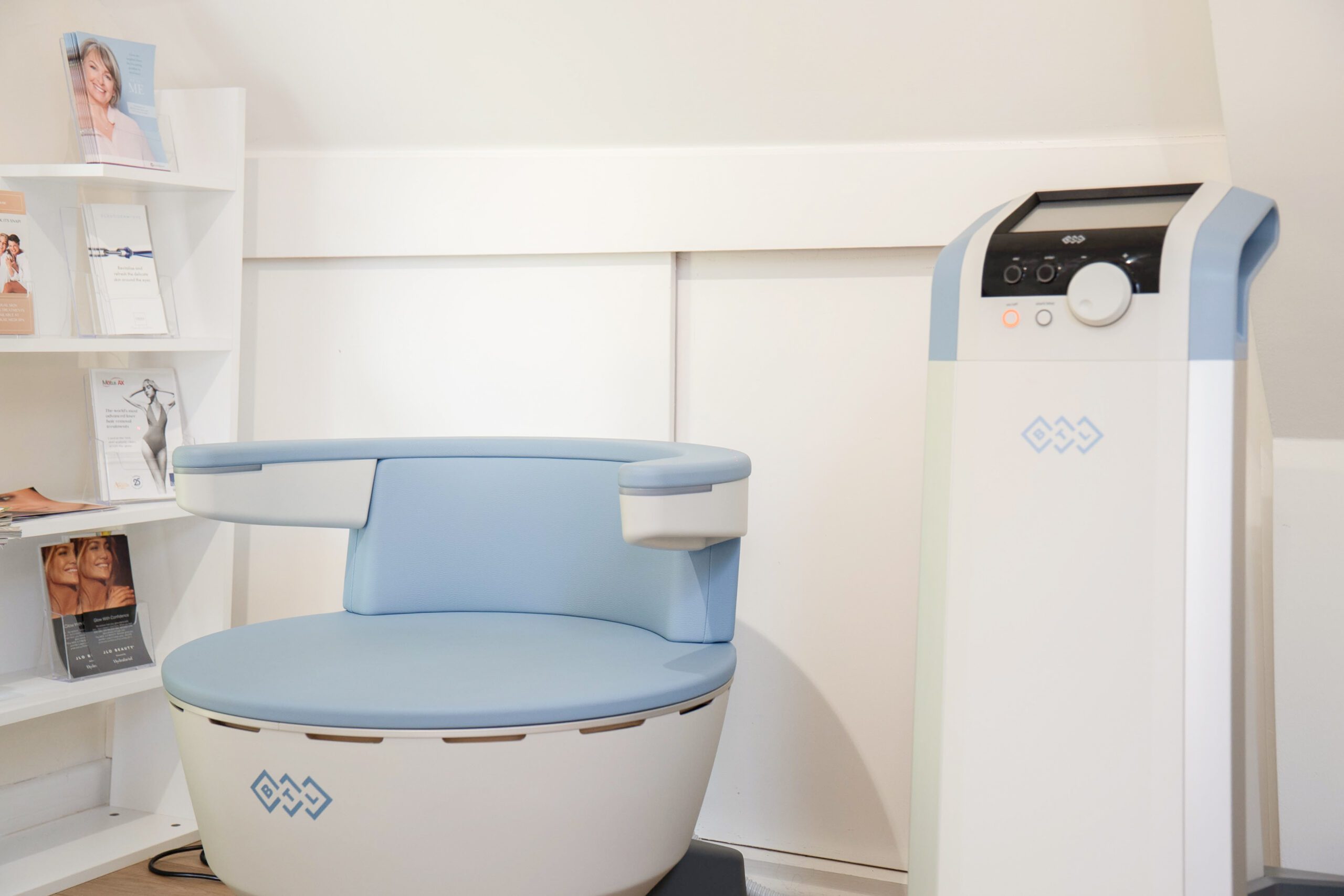
What is EMSELLA?
EMSELLA is a non-invasive treatment designed to stimulate the pelvic floor muscles.
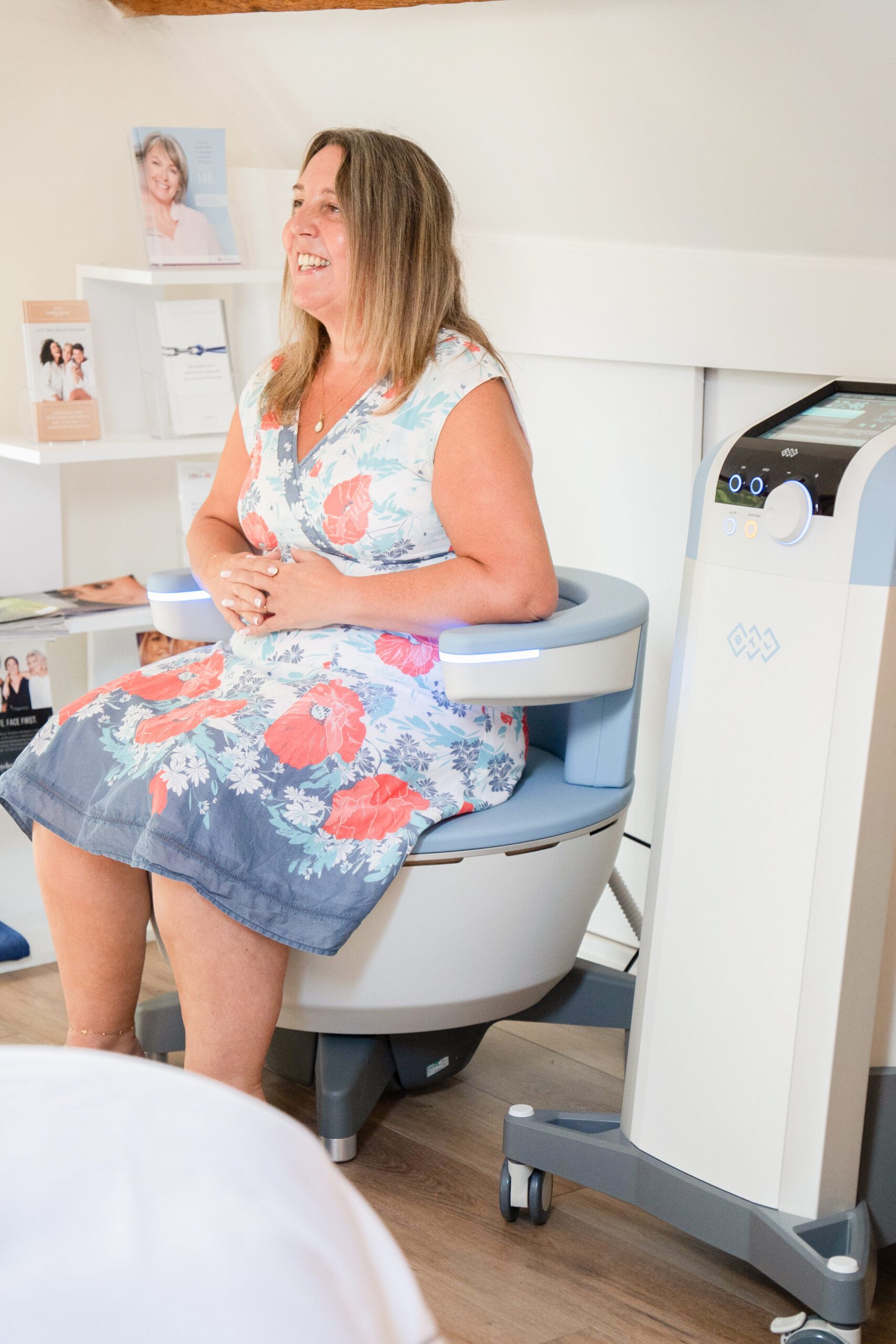
And yes, it really does involve sitting on a chair.
Fully clothed.
No internal treatment.
No needles.
No undressing.
Quite understandably, this is usually the point where people’s interest perks up.
EMSELLA uses high-intensity focused electromagnetic technology, known as HIFEM, to stimulate repeated contractions of the pelvic floor muscles while you are sitting in the chair. The aim is to help strengthen and re-educate those muscles.
At Saddle House, EMSELLA forms part of our wider approach to pelvic health and wellbeing for both women and men.
What does EMSELLA feel like?
This is usually the next question.
You remain fully clothed and sit on the EMSELLA chair while the technology causes the pelvic floor muscles to contract.
You will generally feel a tingling sensation and strong muscle contractions.
It feels unusual.
But there are no needles, probes or invasive procedures involved, and you can return to normal daily activities afterwards.
In other words, one of the more unusual appointments you may ever have.
But certainly not one of the messiest.
How many EMSELLA treatments do you need?
There is no treatment plan we would prescribe to everybody without first talking to them.
BTL describes a typical EMSELLA course as around six sessions, often scheduled twice a week, with individual treatment plans tailored by the provider.
Your own plan will depend on your symptoms, suitability and what we are trying to achieve.
This is why we start with a consultation rather than simply pointing at the chair and saying, “Hop on.”
Does EMSELLA replace pelvic floor exercises?
We would not look at it that way.
Pelvic floor exercises remain an established first-line treatment for urinary incontinence and are an important part of maintaining pelvic floor strength.
EMSELLA is another option that may support suitable clients by stimulating the pelvic floor muscles in a non-invasive way.
As with most things we do at Saddle House, we are much more interested in finding the right combination for the individual than pretending one treatment is the answer to absolutely everything.
No magic wands here. Just a slightly magical-looking chair.
Is EMSELLA suitable for everyone?
No, and this matters.
Bladder leakage can happen for different reasons and not everybody experiencing urinary symptoms will be suitable for EMSELLA.
That is why we want to know what is happening before recommending treatment.
Certain medical conditions and implants can also affect suitability for electromagnetic treatments, so your medical history needs to be discussed properly during consultation.
And if your symptoms have not previously been assessed, have changed suddenly or there is any reason to suspect an underlying medical issue, we may recommend speaking to your GP or an appropriate healthcare professional before going any further.
Good treatment starts with knowing when not to treat too.
Pelvic health should not be embarrassing
This is perhaps the part we care about most.
So many women quietly change their behaviour around bladder leakage.
- They stop running.
- They choose darker leggings.
- They avoid jumping.
- They always go to the toilet before leaving the house.
- They laugh about crossing their legs before sneezing.
Eventually it becomes so normal that they stop thinking of it as something worth mentioning.
But if it is affecting your confidence, exercise, social life or everyday routine, you are allowed to talk about it.
At Saddle House, Chloe specialises in our pelvic health and EMSELLA treatments, and Ellen is also qualified in EMSELLA and passionate about supporting both women and men with their pelvic health.
There is absolutely no need to feel embarrassed.
Trust us.
Bladders are considerably less shocking to us than you might think.
Frequently asked questions about bladder leakage and EMSELLA
Is leaking urine when I sneeze normal?
It is common, particularly in women, but urinary leakage is not something you have to simply accept. Leakage when coughing, sneezing, laughing or exercising is often associated with stress urinary incontinence. It is worth discussing symptoms with your GP so the cause and type of incontinence can be properly assessed.
Can pelvic floor weakness improve?
Yes. Depending on the cause and individual circumstances, pelvic floor muscle training and other treatments can improve urinary incontinence symptoms. Your treatment options will depend on the type and severity of your symptoms.
Do you stay fully clothed during EMSELLA?
Yes. EMSELLA is a non-invasive treatment and you remain fully clothed while sitting on the treatment chair.
Is EMSELLA only for women?
No. EMSELLA can be used for suitable women and men experiencing certain pelvic floor and urinary incontinence concerns.
Where can I have EMSELLA in Hampshire?
Saddle House Medi-Spa offers EMSELLA from our nurse-led clinic in Alresford, Hampshire, a short drive from Winchester.
Ready to talk about your pelvic health?
Whether bladder leakage has been bothering you for years or you have only recently started noticing it, the first step does not need to be complicated.
We can talk through what you have been experiencing, whether EMSELLA may be appropriate and what your next steps could look like.
No embarrassment. No awkwardness.
And absolutely no need to cross your legs before you walk through the door.
